- Home
- Application
-
Aluminum Sheet Substrate for Curtain Wall Panels
Email:sales@alummc.com
WhatsApp:+86-18703635966
Get a quotation -
Products
Email:sales@alummc.com
WhatsApp:+86-18703635966
Get a quotationProducts
HAOMEI Aluminum is a large-scale aluminum sheet manufacturer integrating R&D, production, and sales. We supply curtain wall aluminum sheets in 1060, 1100, 3003, 3004, 5005, and 5052 alloys. Customized sizes and specifications are available to meet diverse project requirements.
Curtain wall aluminum sheet substrate is the fundamental raw material used in aluminum veneer curtain wall systems. It determines the mechanical stability, fabrication compatibility, coating adhesion, and long-term service life of the finished curtain wall panel. Unlike ordinary decorative aluminum sheets, aluminum substrates for curtain wall applications undergo strict rolling, tempering, and surface-quality control processes.
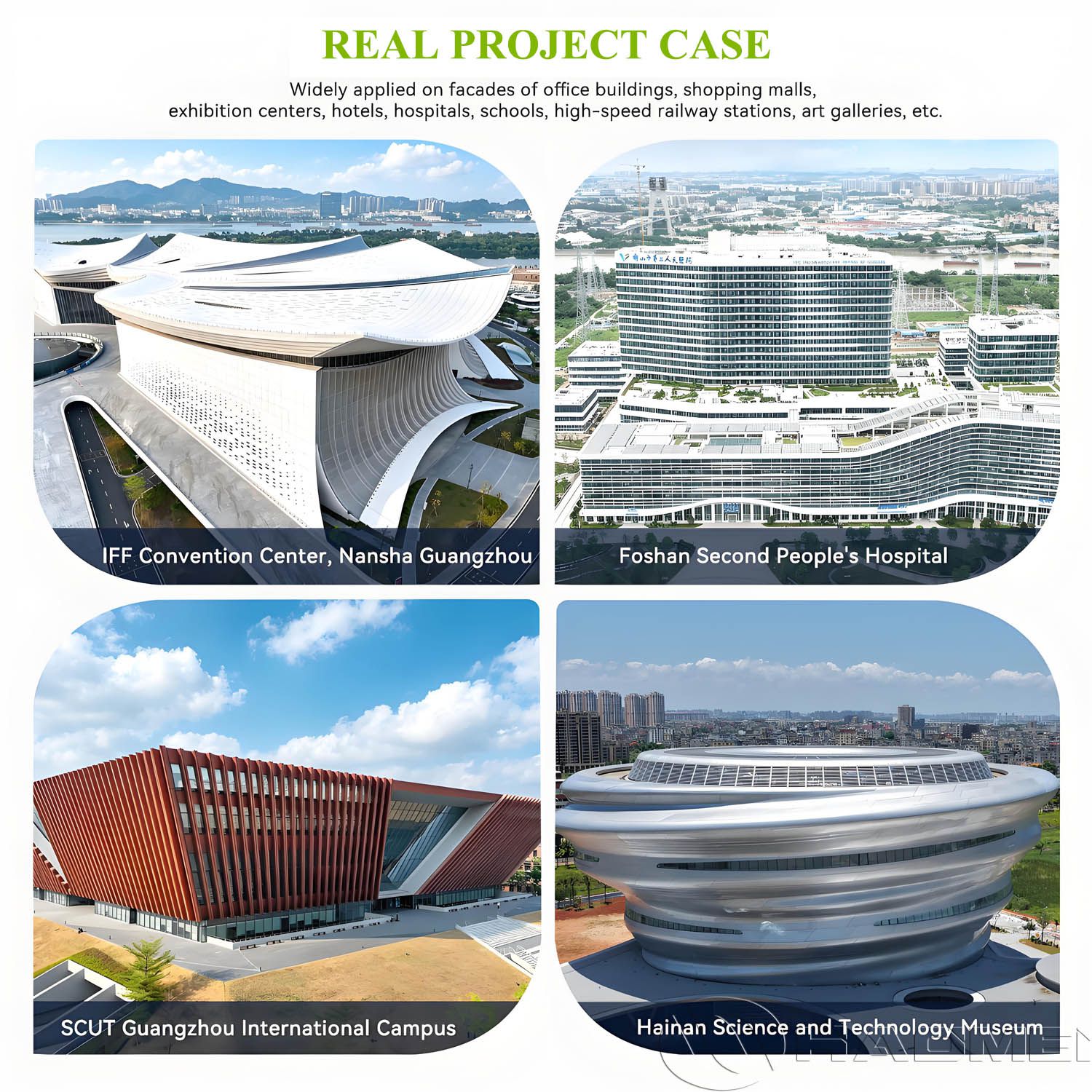
They provide dependable structural support for building façades and serve as the base material for PVDF fluorocarbon coatings, polyester coatings, and other surface-finishing systems. Curtain wall aluminum substrates are widely used in commercial complexes, high-rise buildings, public venues, industrial parks, and other architectural exterior wall projects.
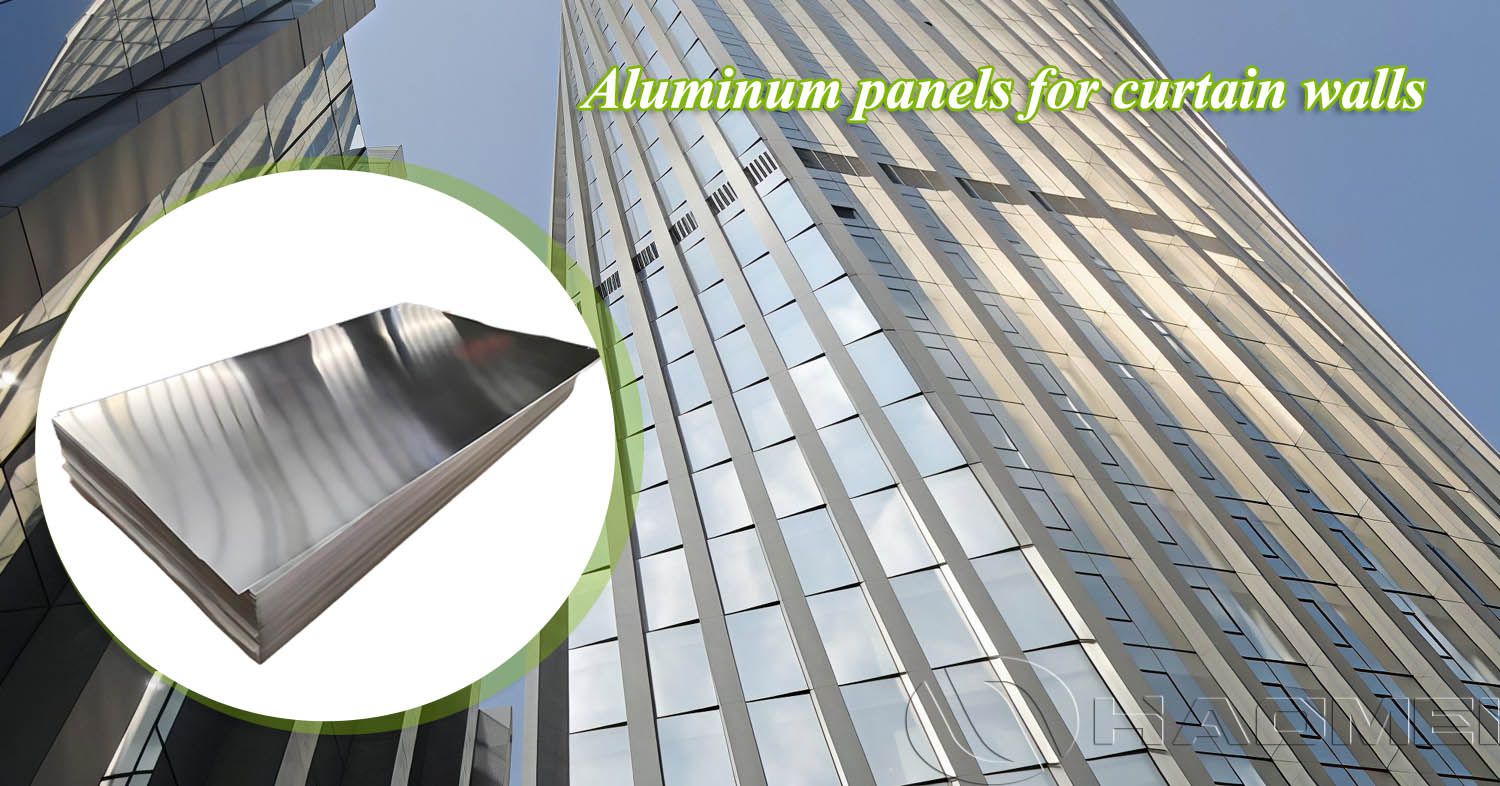
Curtain wall projects select aluminum alloy grades according to building height, wind-load requirements, and service environments, such as inland areas, coastal regions, or industrial zones. The commonly used alloy grades are mainly divided into the following categories:
3003 Aluminum Alloy – Aluminum-Manganese Alloy
3003 is the most widely used substrate for curtain wall panels in China. The addition of manganese increases its strength by approximately 20% compared with pure aluminum while maintaining excellent bending and forming performance.
It offers a balanced cost-performance ratio and is suitable for most conventional curtain wall projects in inland cities. It can be easily processed through edge folding, corner cutting, grooving, punching, and other sheet-metal fabrication operations.
The common temper is H24, which provides a good balance between strength and ductility, reducing the risk of cracking during processing. It is a preferred choice for standard exterior wall applications.
5005 and 5052 Aluminum Alloys – Aluminum-Magnesium Alloys
5005 and 5052 are high-strength and corrosion-resistant aluminum substrates. Magnesium gives these alloys higher yield strength and excellent salt-spray resistance, making them suitable for coastal areas with high salinity, acid-rain regions, and industrial environments with higher corrosion risks.
5005 aluminum sheet offers a uniform anodizing effect and is commonly used in premium curtain wall projects requiring anodized finishes.
5052 aluminum sheet has stronger mechanical properties and is often preferred for high-rise buildings and projects exposed to high wind pressure. It provides excellent dent resistance and deformation resistance.
1xxx Series Pure Aluminum – 1060 and 1100
1060 and 1100 aluminum sheets feature excellent plasticity and formability but relatively low strength. They are generally used for interior decorative curtain walls, low-rise building lining panels, or non-structural decorative applications. They are rarely recommended as substrates for aluminum veneer panels on high-rise exterior walls.
From the current market perspective, 3003 aluminum alloy sheet remains the mainstream material for aluminum veneer curtain wall substrates. Most domestic aluminum veneer manufacturers use 2.5 mm thick 3003 aluminum sheet as the standard configuration, while some high-rise or special projects use 3.0 mm thickness for an additional safety margin.
The temper designation of aluminum alloy sheet represents its work-hardening and annealing condition. For curtain wall substrates, the two most common tempers are H24 and H14.
H24 Temper
H24 refers to aluminum sheet that has been strain-hardened and then partially annealed. It provides higher strength, good flatness, and stronger resistance to wind pressure and thermal deformation.
H24 is the preferred temper for aluminum veneer curtain wall panels. It has relatively low springback after grooving and bending, helping the fabricated panels maintain a flatter surface and reducing the possibility of warping after installation.
H14 Temper
H14 is a strain-hardened temper with better ductility and formability. It is easier to process into complex curves, irregular shapes, and double-curved aluminum panels. However, its strength is slightly lower than H24, and large flat panels may be more likely to show surface waviness.
Therefore, H14 is commonly used for special-shaped, curved, and double-curved aluminum curtain wall panels.
Why O Temper Is Not Recommended
Fully soft O temper aluminum sheet is generally not recommended for curtain wall substrates. Its rigidity is insufficient, and it can easily deform under temperature changes and wind loads, resulting in an uneven or wavy façade appearance.
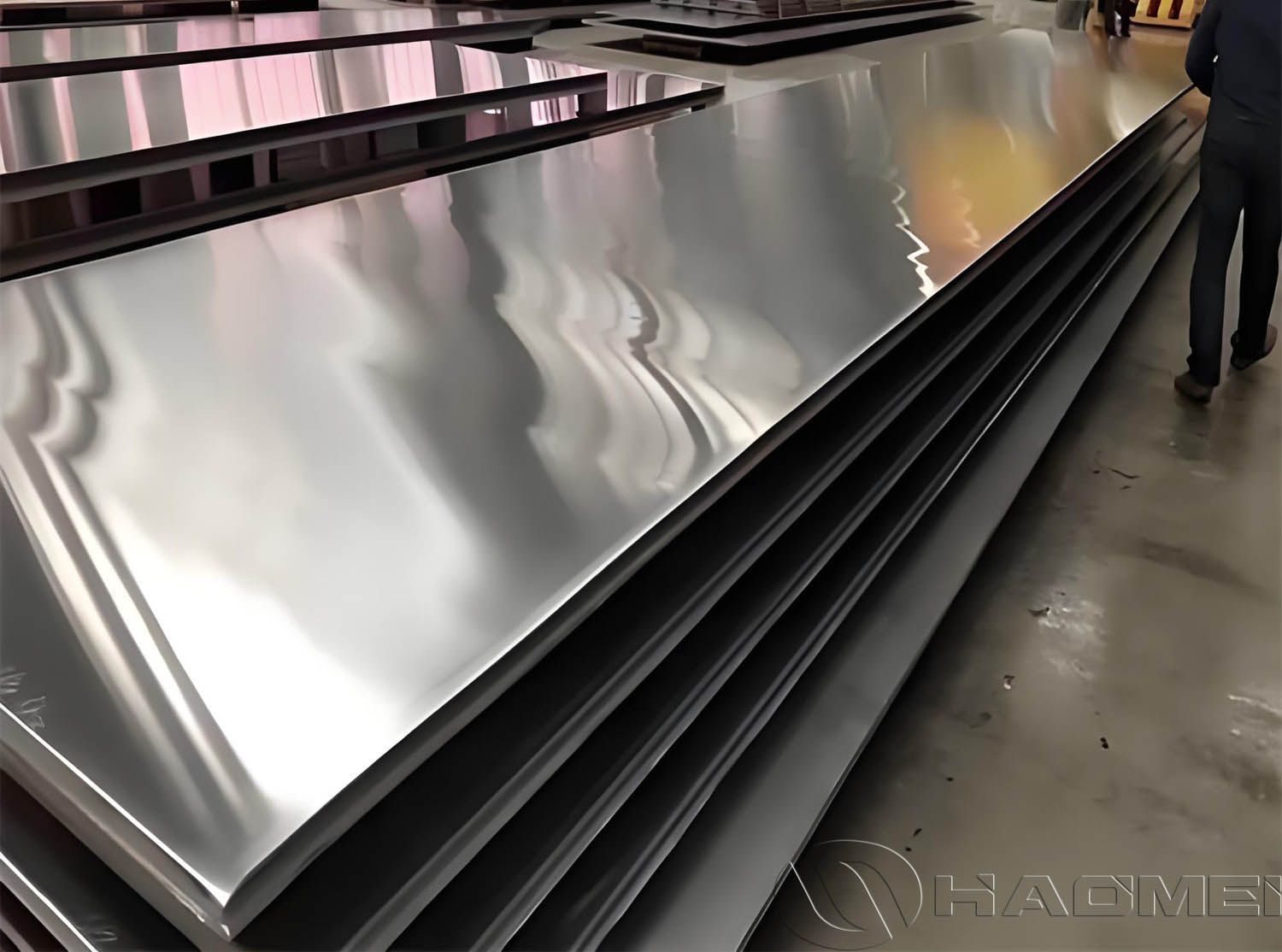
1. Good Strength and Rigidity
Curtain wall aluminum sheet can withstand wind loads, temperature fluctuations, and self-weight. The sheet thickness, stiffeners, and supporting structures should be properly matched to prevent deformation.
2. Excellent Flatness and Surface Quality
High-quality curtain wall aluminum sheet has a flat and uniform surface without obvious scratches, dents, pressure marks, or other defects, helping ensure a consistent and attractive architectural appearance.
3. Good Fabrication and Forming Performance
The material is suitable for cutting, bending, grooving, punching, and other fabrication processes. Good formability reduces the risks of cracking, damage, and deformation during manufacturing.
4. Reliable Weather Resistance and Surface Treatment Compatibility
Curtain wall aluminum substrates can withstand sunlight, rain, humidity, and other outdoor environmental conditions. They are compatible with coating systems such as PVDF fluorocarbon coating, ensuring long-lasting façade durability and appearance.
| Item | Specification |
| Alloys | 1060, 1100, 3003, 3004, 5005, 5052, etc. |
| Temper | H14, H24 |
| Thickness | 2.0–3.0 mm |
| Width | 100–2650 mm |
| Length | 1000–16000 mm |
| Coating | PVDF fluorocarbon coating |
| Flatness | Camber height ≤ 3 mm within any 1 m length |
| Diagonal Tolerance | ≤ 2 mm |
| Edge Quality | Neatly trimmed edges without burrs, cracks, or splits |
| MOQ | 1–3 metric tons |
| Substrate Thickness | Thickness Tolerance | Recommended Maximum Panel Size | Typical Applications |
| 2.0 mm | ±0.10 mm | ≤1000 mm | Interior curtain walls and small decorative panels |
| 2.5 mm | ±0.12 mm | 1000-1500mm | Standard exterior curtain walls and multi-story buildings |
| 3.0 mm | ±0.15 mm | 1500-200mm | High-rise curtain walls, large panel modules, and high-wind-pressure areas |
| 3.5 mm | ±0.17 mm | Over 2000 mm; cantilevered sections | Extra-large panels and major coastal engineering projects |
| Alloy | Temper | Tensile Strength Rm (MPa) | Yield Strength Rp0.2 (MPa) | Elongation A50mm (%) |
| 3003 | H24 | 140-180 | ≥115 | ≥6 |
| 3003 | H14 | 130-170 | ≥100 | ≥8 |
| 5052 | H24 | 150-190 | ≥125 | ≥5 |
| 5052 | H14 | 140-180 | ≥110 | ≥7 |
Before aluminum sheet substrates are installed as finished curtain wall panels, they must undergo a series of precise fabrication and treatment processes. The quality of these processes directly determines whether the material performance can be fully realized in the final product.
Sheet Metal Fabrication
Sheet-metal fabrication is the first step in forming aluminum curtain wall panels. It includes cutting, punching, corner notching, grooving, and bending.
Bending places direct requirements on the ductility of the aluminum substrate. Sheets with insufficient elongation may develop microcracks along the bending area, creating potential corrosion risks in the future.
For aluminum panels longer than 1 meter, stiffeners are typically fixed to the back side of the panel to compensate for the limited rigidity of thin sheets. The usual spacing between stiffeners is approximately 500–800 mm.
Surface Pretreatment
Surface pretreatment acts as the bridge between the aluminum substrate and the coating. After fabrication and before coating, aluminum panels need to undergo degreasing and chromating, or a chromium-free silane treatment.
Degreasing removes oil, dirt, and other contaminants from the surface.
Chromating or silane treatment forms a conversion coating on the aluminum surface. This thin layer improves the corrosion resistance of the substrate and significantly enhances adhesion between the aluminum sheet and the fluorocarbon coating.
The quality of pretreatment often determines whether the coating will remain intact after decades of exposure to sunlight, rain, humidity, and other outdoor conditions. Poor pretreatment may lead to coating blistering, peeling, and premature failure.
Surface Coating
Although surface coating is not part of the substrate itself, it is closely related to substrate performance. Curtain wall aluminum panels generally use PVDF fluorocarbon coating.
The coating thickness should generally be no less than 30 μm. For coastal regions and areas with severe acid rain, a coating thickness of 40 μm or above is recommended. The PVDF resin content should not be lower than 75%.
A high-quality coating system isolates the aluminum substrate from corrosive media, allowing aluminum curtain wall systems to achieve a design service life of more than 25 years.
Misunderstanding 1: The Thicker the Aluminum Sheet, the Better
Sheet thickness should be determined according to panel size, wind pressure, building height, and structural calculations. Blindly increasing thickness raises material cost and panel weight. With proper design and stiffener reinforcement, thinner aluminum sheets can also achieve stable performance.
Misunderstanding 2: A Good Coating Means the Substrate Does Not Matter
The coating is only a protective layer. Once the coating is damaged, a low-quality substrate may corrode rapidly. The substrate is the structural foundation of the panel. Coating failure may initially affect appearance, but substrate failure can create structural safety concerns.
Misunderstanding 3: 3003 Can Always Replace 5005
3003 aluminum sheet offers excellent cost performance in inland environments. However, in coastal salt-spray environments or industrial areas with strong corrosion, the corrosion resistance of 3003 may not be sufficient for long-term use. Therefore, 3003 should not be used as a direct substitute for 5005 or 5052 without proper evaluation.
Misunderstanding 4: Only Checking Finished Samples Instead of Verifying Material Reports
When purchasing aluminum sheet substrates, buyers should verify the material certificate, alloy composition, mechanical properties, and salt-spray test reports. On-site spectrometer testing can also be used to confirm the alloy grade and prevent the use of inferior or substituted materials.
WELCOME TO CONTACT US
Your information is for contact only and will not be shared with any third party.