1050 vs. 1060 Aluminum Sheet: What Is the Difference?
Tags: 1050 vs. 1060 aluminum, 1050 aluminum sheet, 1060 aluminum sheet, aluminum alloy comparison, aluminum sheet manufacturer, commercial pure aluminum sheet, 1000 series aluminum sheet
Meta Description: Compare 1050 and 1060 aluminum sheets in terms of chemical composition, electrical conductivity, mechanical properties, processing performance, and applications. Find the right aluminum grade for your project.
In industrial manufacturing, architectural decoration, electronics and electrical equipment, transportation, and consumer-product fabrication, aluminum sheet is widely used because of its light weight, corrosion resistance, excellent thermal and electrical conductivity, and ease of forming.
Among the many aluminum sheet grades available, 1050 and 1060 aluminum sheets are both common commercial pure aluminum products. They have a similar appearance and closely related properties, and both offer excellent ductility and processing performance. As a result, many buyers find it difficult to distinguish between them during material selection and procurement.
So, what are the actual differences between 1050 and 1060 aluminum sheet? How should you select the appropriate grade according to your project requirements?
This article provides a detailed comparison of 1050 and 1060 aluminum sheets in terms of chemical composition, mechanical properties, formability, electrical and thermal conductivity, applications, and purchasing recommendations.
Basic Overview of 1050 and 1060 Aluminum Sheet
Both 1050 and 1060 aluminum sheets belong to the 1000 series aluminum family, also known as commercial pure aluminum sheets. The 1000 series is primarily composed of aluminum and is not designed for high-strength structural applications. Instead, it is valued for the inherent advantages of aluminum, including excellent electrical conductivity, thermal conductivity, corrosion resistance, ductility, and workability.
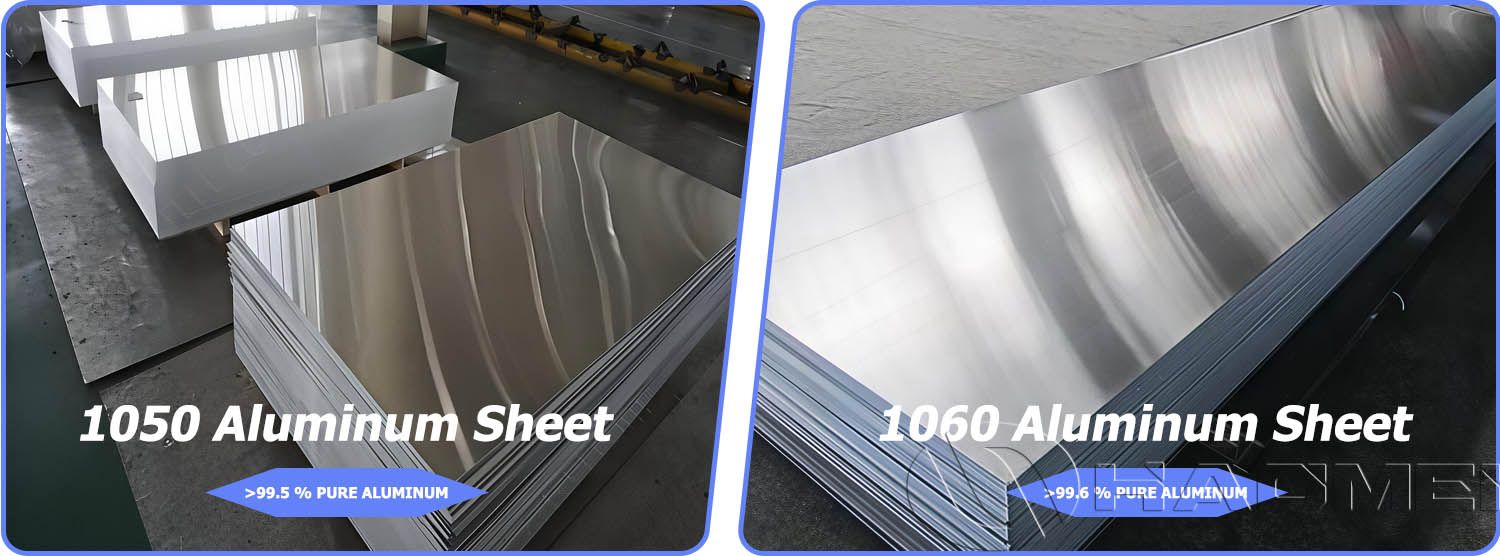
1050 aluminum sheet: aluminum content is generally not less than 99.50%.
1060 aluminum sheet: aluminum content is generally not less than 99.60%.
As indicated by the alloy designations, 1060 aluminum has a slightly higher aluminum content than 1050 aluminum. Although the difference is only approximately 0.10%, it can result in certain differences in material purity, impurity levels, electrical and thermal conductivity, corrosion resistance, and performance in specific fabrication processes.
It should be noted that the exact chemical composition range, mechanical properties, and technical requirements should always be confirmed according to the purchase contract, applicable product standards, and the technical agreement between supplier and buyer.
Common Specifications of 1050 and 1060 Aluminum Sheet
| Item | Available Specification |
| Alloy | 1050 / 1060 |
| Temper | O / H12 / H14 / H16 / H18 / H24 |
| Thickness | 0.2–6.0 mm |
| Width | 100–2000 mm |
| Length | 500–6000 mm |
| Surface | Mill finish / Polished / Brushed |
| Processing | Cutting / Slitting / Custom fabrication |
| Standards | ASTM B209 / EN 485 |
| Packaging | Export-standard wooden pallets |
| MOQ | 1–3 tons |
1050 vs. 1060 Aluminum Sheet
Chemical Composition Comparison
Chemical Element | 1050 Aluminum (%) | 1060 Aluminum (%) |
| Aluminum (Al) | ≥99.50 | ≥99.60 |
Silicon (Si) | ≤0.25 | ≤0.25 |
| Iron (Fe) | ≤0.40 | ≤0.35 |
| Copper (Cu) | ≤0.05 | ≤0.05 |
| Manganese (Mn) | ≤0.05 | ≤0.03 |
| Magnesium (Mg) | ≤0.05 | ≤0.03 |
| Zinc (Zn) | ≤0.05 | ≤0.05 |
Key difference:
1060 allows for slightly higher silicon and iron content (0.06% vs. 0.05%), which results in marginally better mechanical properties but slightly lower electrical conductivity compared to 1050.
1050 has a higher level of purity, making it suitable for applications that demand exceptionally high electrical conductivity.
Mechanical Properties
1. Strength
Both 1050 and 1060 are commercial pure aluminum grades. Their base strength is relatively low compared with alloy series such as 3000, 5000, or 6000 aluminum. Therefore, they are generally not recommended for high-load or high-strength structural components.
The strength of both grades is strongly influenced by temper. For example, tensile strength and hardness vary significantly among O, H12, H14, H16, and H18 tempers.
Under the same temper condition:
1050 and 1060 aluminum sheets have generally similar mechanical strength.
1050 may offer slightly higher strength in certain conditions because of its relatively higher impurity content.
1060 is generally softer and more ductile because of its higher aluminum purity, making it more suitable for forming and drawing operations.
However, these differences are not absolute. Actual mechanical properties are also affected by melting quality, rolling process, annealing process, sheet thickness, and delivery condition. When a project has specific strength requirements, buyers should refer to the actual mechanical test data rather than selecting material based solely on alloy grade.
Typical Mechanical Properties
| Property | 1050 Aluminum Sheet | 1060 Aluminum Sheet |
| Tensile Strength | 70–90 MPa | 80–110 MPa |
| Yield Strength | 35–45 MPa | 40–50 MPa |
| Elongation | ≥12% | ≥10% |
Note: The values above are for reference only. Actual values vary with temper, thickness, product standard, and production process.
2. Electrical Conductivity
Electrical conductivity is an important factor when aluminum sheet is used for electrical equipment, conductive components, capacitor shells, busbar-related applications, or electronic products.
Both 1050 and 1060 aluminum offer good electrical conductivity because of their high aluminum content. However, where higher aluminum purity and conductivity are required, 1060 aluminum is generally preferred.
Actual electrical conductivity depends on chemical composition, temper, processing history, and product condition. Buyers should confirm conductivity requirements through material test reports rather than assuming a fixed performance difference based only on alloy designation.
| Property | 1050 Aluminum Sheet | 1060 Aluminum Sheet |
| Electrical Resistivity | Approx. 0.0282 Ω·mm²/m | Approx. 0.0285 Ω·mm²/m |
Note: Electrical resistivity data may vary depending on material condition and testing standards. Please confirm specific requirements with the supplier.
3. Thermal Conductivity
Both 1050 and 1060 aluminum sheets possess good thermal conductivity, making them suitable for applications such as radiators, heat exchangers, cookware, lighting fixtures, and electronic heat-dissipation components.
By comparison, 1060 aluminum sheets—due to their slightly higher purity—generally offer superior thermal conductivity. Consequently, 1060 aluminum is particularly well-suited for environments that require rapid heat transfer and high heat-dissipation efficiency, such as LED cooling plates, heat sinks for electrical appliances, and components for heat-exchange equipment.
4. Corrosion Resistance
Pure aluminum develops a natural passive oxide film on its surface, which provides good corrosion resistance in normal atmospheric environments.
Both 1050 and 1060 aluminum sheets offer reliable corrosion resistance in indoor, outdoor, humid, and mildly corrosive environments. Because 1060 generally contains fewer impurities, it may provide slightly more stable resistance to localized corrosion, such as pitting, in certain humid or mildly acidic service conditions.
However, neither 1050 nor 1060 aluminum is recommended for direct exposure to strong acids or strong alkalis without appropriate protective treatment.
5. Surface Quality
Both 1050 and 1060 aluminum sheets can achieve good flatness and surface brightness through controlled rolling processes.
Due to its lower impurity content, 1060 aluminum often provides more uniform color and better consistency after anodizing. It is therefore particularly suitable for appearance-sensitive products, decorative panels, nameplates, signage, and anodized components.
1050 aluminum is also suitable for conventional anodizing and surface finishing. However, for demanding decorative applications where color consistency and surface uniformity are critical, 1060 aluminum may offer better batch-to-batch stability.
6. Fabrication and Formability
Both 1050 and 1060 aluminum sheets have excellent ductility, plasticity, and cold-working performance. They are suitable for a wide range of sheet-metal fabrication methods, including:
Stamping
Deep drawing
Bending
Cutting
Spinning
Rolling
Welding
Embossing
Surface finishing
Because of its higher purity and softer material characteristics, 1060 aluminum sheet often performs especially well in deep drawing, stretching, spinning, and other forming processes requiring high elongation.
1050 aluminum sheet is also suitable for general stamping and bending applications and is often favored for its cost-effectiveness.
For complex forming parts, O temper soft aluminum sheet is generally recommended. For products requiring better shape retention, stiffness, and surface flatness, semi-hard or hard tempers such as H14, H16, and H18 may be selected.
Typical Applications of 1050 Aluminum Sheet
1050 aluminum sheet is commonly used in cost-sensitive applications where formability and general structural functionality are the primary requirements. Examples include heat sink fins, substrates for lighting reflectors, standard stamped parts, gaskets, low-stress corrosion-resistant components for chemical equipment, and various deep-drawn vessels. In its strain-hardened state, it offers slightly higher strength, making it suitable for brackets or similar parts that require a moderate degree of rigidity.
1060 aluminum sheet, by contrast, is typically chosen for applications that demand higher purity, superior corrosion resistance, or specific surface finishing results. It is frequently used for components requiring anodizing, shielding for electronic devices, signage and decorative panels, power capacitor housings, parts requiring complex deep-drawing, and conductive connectors that demand excellent weldability and electrical conductivity. For products requiring long-term weather resistance or consistent results from subsequent surface treatments, 1060 is the more reliable choice.
There is also significant overlap between the two; for general deep-drawn parts, standard heat-dissipation components, and various packaging or container applications, 1050 and 1060 are often interchangeable. In such cases, the selection is typically driven by factors like material temper, price, and stock availability.
Quick Comparison: 1050 vs. 1060 Aluminum Sheet
Comparison Item | 1050 Aluminum Sheet | 1060 Aluminum Sheet |
| Aluminum Content | ≥99.50% | ≥99.60% |
| Electrical & Thermal Conductivity | Good | Excellent; commonly selected for higher-purity applications |
| Deep Drawing Performance | Suitable for ordinary bending and stamping | Better suited for complex deep drawing and multi-step stretching |
| Anodizing | Suitable, but color variation may occur | More uniform anodizing and stable gloss |
| Corrosion Resistance | Good atmospheric corrosion resistance | More stable corrosion resistance under similar conditions |
| Price | Generally lower | Slightly higher |
| Market Position | Economical, general-purpose pure aluminum sheet | High-performance, versatile commercial pure aluminum sheet |
| Typical Applications | General processing, decoration, common industrial parts | Conductive, heat-transfer, deep-drawing, and higher-purity applications |
Why Choose HAOMEI Aluminum Sheet?
HAOMEI is an aluminum sheet manufacturer and supplier offering a wide range of aluminum products for industrial and commercial applications.
We supply 1050, 1060, and other aluminum alloy sheets in different thicknesses, widths, tempers, and surface finishes to meet the requirements of customers worldwide.
Our advantages include:
Multiple alloy options: Commercial pure aluminum and a variety of aluminum alloy grades.
Customized dimensions: Flexible options for thickness, width, length, and temper.
Quality assurance: Inspection of chemical composition, mechanical properties, dimensions, and surface quality.
Professional processing: Aluminum sheet cutting, slitting, brushing, film lamination, and customized solutions.
Export experience: Professional export packaging and international logistics support.
Whether you require 1050 aluminum sheet for general industrial manufacturing or 1060 aluminum sheet for electrical, thermal, deep-drawing, or anodizing applications, we can help you select the right material according to your technical requirements.
HAOMEI Aluminum can supply 1050 and 1060 aluminum sheets in a full range of tempers, including O, H12, H14, H16, H18, and H24. Thicknesses from 0.1 mm to 200 mm are available. We also provide custom cut-to-length processing, sheet leveling, protective film lamination, brushing, shearing, and slitting services.
Material certificates and SGS test reports can be provided upon request. We support both domestic projects and export orders, and accept sample orders as well as bulk purchases.